.

Self-Transformations: Writing Faith Journeys in Verse – Alan Spence

Alan Spence

I recently took part in a conference (organised by the Edinburgh International Centre for Spirituality and Peace) on the great Scottish novelist Neil Gunn.

Late in his life Gunn developed an interest in Eastern spirituality, in particular Zen Buddhism. Some of his mature writings, reflecting this, were greeted with a kind of bewilderment and bemusement. However, for Gunn this Eastern culture was not something alien or esoteric. On the contrary, he felt very much at home with it, found it somehow familiar. In his own words, he found it ‘very like the thing!’  He recognised also that there were elements of this culture that echoed aspects of his own Celtic heritage – a closeness to nature, a clear-eyed looking into the heart of things.  We all know those little moments of awakening, a kind of insight, where we feel in touch with a deeper part of ourselves, profoundly connected to the world around us. The struggle to express this awareness may lead us in interesting directions in terms of language and form.

In the workshop I will use the haiku form as a way of catching those little moments of grace. But I’ll also use poems from East and West (for example poems by Rumi, or Mary Oliver) which consciously use the language of devotion and praise.

Here’s a little piece by my own teacher, Sri Chinmoy, which captures that sense of recognition, of familiarity, of coming home to what feels ‘very like the thing.’

EVER THE SAME AGAIN

Ever the same again
My lost truth rediscovered.
Ever the same again.

Ever the same again,
My forgotten self remembered.
Ever the same again.

Ever the same again,
My lost goal regained.
Ever the same again.


Self-Transformations: Writing Faith Journeys in Verse – Georgi Gill

Georgi Gill - Learning Manager at Scottish Poetry Library

When Hephzibah contacted the Scottish Poetry Library to discuss her ideas for a series of poetry workshops exploring faith, conversion and spiritual awakenings, I was fascinated from the outset.

To lay my cards on the table, I don’t approach the subject of faith from a conventional or easily defined position. As the daughter of a lapsed Methodist mother and a sometime Buddhist father, my spiritual cultural inheritance is something of a hotchpotch. I practise meditation fairly regularly and, like most British people who wouldn’t describe themselves as Christian, each year I relish wrapping presents and scoffing mince pies while a choir sings Christmas carols on the radio. The nearest I can come to defining my position is agnostic: I have faith in my doubt.

God may, for me, ultimately be unknowable but that doesn’t discourage me from trying. Similarly, I don’t think I’ll ever write a perfect poem, but that only encourages me to write more. Poetry is a form we can all employ to explore our own feelings and experiences. It’s a way of getting to know ourselves better, of trying to understand that which is complex and also celebrate that which, of itself and in itself, is simple but hard to articulate. No wonder then that people have turned to poetry for millennia to record, express and share their spiritual lives. Prayers, litanies, gitas, hymns and mantras are intrinsic to all spiritual cultures. They are the metaphors we create to find a way of sharing what we feel, what we believe and what we want to share or teach. I’m really excited about the forthcoming workshops as opportunities for participants and facilitators to find the language and metaphor that will best translate and express our personal, lived experiences.

Download the Self-Transformations Poetry Workshop poster (PDF)


Georgi Gill is the Learning Manager at the Scottish Poetry Library


Translation and Religion: the three days

The three days went so quick that it was time to say our goodbyes before we knew it. This indicates of course just how engaged we were discussing the themes of the conference, each others’ research papers and sharing meals. We had a rich combination of presentations addressing translation in a range of religions, languages and regions. It was a great opportunity to compare notes and to see what similarities and differences we could identity in each other’s research area. One thing was clear, we needed more research in this area and, as far as possible, across more languages and religions. We’ve got pictures from our last day of course but what’s more fun is that Eric Reinders, one of our presenters, offered to turn these into an ink drawing!


Annie’s thoughts…

The remit I had for this reading differed from my usual writing/dramaturgy process, in that I usually work from original writing, in consultation with the author, and with the ability to re-write material. This time I was working with text that had existed for decades and with no authors to consult with. The brief was to stick to the original text, adapting, but not re-writing, so that the words came directly from the accounts of the authors, in their time.

In order to make the reading live for an audience I had to find the drama in the accounts, which at times was challenging, given that sometimes, the writing could be quite dry – worthy and factual. By looking at the sub-text, and getting to know more about the times that the converts lived in, their locations and social status, I was able to form a clearer picture of the people behind the accounts. The key questions for me were: why did they convert, and what was at stake in doing so?

Not being a person of faith myself, I had to find a way to give the accounts some kind of context and understanding, that I from my 21st-century perspective could empathise with, in order to convey it to a mixed audience. I read through the (mainly 19-Century) research material that Hephzibah gave me, and saw how different each author’s journey towards conversion was. I felt it was important to depict that difference, and the sense of their undergoing a powerful psychological and emotional journey, as well as the ramifications of how they would be regarded by family, friends and authorities, and manifest a fundamental change in the way they would continue to live, from day to day.

With this in mind I structured the reading by creating an introduction read by Hephzibah to give a historical context to the subject matter of the project, and then shorter introductions to set the scene for each extract. I performed each character with a different voice and each section was punctuated with music by composer Niroshini Thambar, giving texture and form to the reading.

I’m looking forward to exploring more materials from the research project, using it as stimulus to create a play, which gives a more rounded picture of how these experiences, and the political and social settings in which they occurred, affected and shaped Indian history of that period and beyond, for a contemporary audience.


A Battle for the Soul: The Evening

Battle for the Soul event at the Edinburgh Storytelling Centre

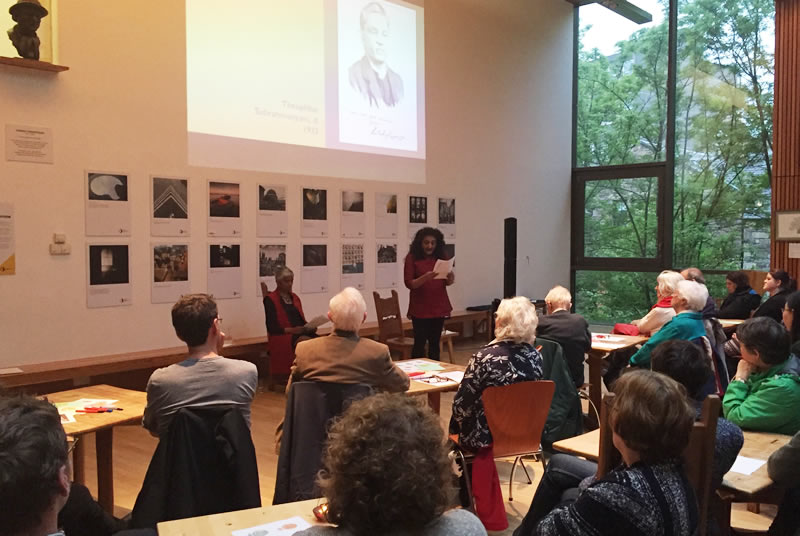
Doors to the Storytelling Court open at 8pm and people start walking in. A live, human audience—not just the figments of my imagination I’ve addressed during our practice runs! This is exciting.

John gives a brief introduction, the lights dim, the projections and the music come on. Annie and I walk to the front and wait for the images and music to fade. We each speak our part. I introduce each narrative section, making the link to the longer accounts from which these have been extracted as well as the fabric of history and culture within which these conversion stories are embedded.

Annie’s reading brings each ‘convert’-writer to life. These are no longer forgotten converts whose writings are obscure and irrelevant in the present. Each account has a distinct voice, becomes an individual speaking to us of how they grappled with questions of faith and belief, the excitement or pain of finding unexpected answers, and how their families respond to their decisions. The pieces of music that Niroshini weaves around Annie’s reading beautifully sets the emotional tone for each narrative. I can see the audience is captivated by the inherent drama of these lives.

The final applause is warm and enthusiastic. John invites all to stay with us for wine, canapés and discussion. And, everyone does, which is great! It is clear people are very interested in engaging with these stories and their implications, both historically and at present. After I give a brief introductory comment on the themes of the project, linking autobiography, religious conversion and language use, we open the floor to questions. There are comments and questions from the audience on different aspects of the narratives and we discuss motivations for conversion, the role of missionaries, conversions between other religions in South Asia, and the contemporary situation in South Asia. To be honest, most questions in some form or other return to the issue of motivation: why did these individuals really convert?…a question that is still very relevant today in contemporary South Asian political life.

It is the different layers of conflict that seems to have captured the imagination of the audience: the inner, psychological conflict competing with social conflicts and economic considerations. Thanks to Annie for selecting and juxtaposing the passages in such a way that these several conflicts play off of one another, making this a complex history to grapple with. Her sensitive rendering of the several voices was moving and yet provoked us all to ask critical questions of these life choices.

If you attended this event or are interested in other related events, please return to this website for more information on the project and other planned events in Edinburgh and London.

Audience feedback

storytelling-event_013
previous arrow
next arrow

Translation and Religion: Interrogating Concepts, Methods and Practices

conference-1-3-sep-2016-poster

The response to our call for papers was marvellously enthusiastic. With nearly fifty abstracts, balancing quantity with quality was a difficult task. We had at least 20-25 good abstracts and if time permitted, we would have been delighted to include more than the current 15 papers that we selected. Our aim was to ensure a good range of religions, regions and languages to enable discussion across various translation and religious traditions.

Apart from these, our two keynote speakers, Alan Williams and Arvind Pal Mandair, have sent us stimulating abstracts that focus on the conceptual and methodological challenges that accompany the study of religions in translation.

Alan speaks on Thursday afternoon, September 1, on the much translated poetry of the thirteenth-century mystic Rumi, which historically “helped to spread the religious teaching of Sufi Islam across the Persianate world, to South and South-East Asia as far as China and Indonesia.” He will focus on the current popularity for Rumi’s poetry in the West through various translations offered in English which are “now a multi-million-dollar industry that has commodified Rumi as a brand of ‘universal love poetry’” but which has also “excised [it] from its Islamic context and aimed at the self-improvement market in the West.” Alan addresses a significant tension familiar to many in translation studies: how do we study the relation between academic, scholarly translations and those of “‘free-lance’ translators in the market economy of translation”? And, what bearing does this have in particular on the translation of sacred texts?

On Friday morning, September 2, Arvind examines a new method for engaging the two distinct fields of translation studies and the study of religions by examining the conceptual connection between the categories ‘religion’ and ‘translation’. In conjunction with this strand of enquiry, he will investigate “the nature of the contact zone” between disparate cultures, peoples and texts as a “regime of representation”, which influenced the encounter between Indian and Western contexts. I look forward to hearing him speak on how South Asians were converted to modernity through the translation of their religious traditions into recognizable ‘religions’, an aspect that the project team have been discussing in relation to some of the Tamil and Marathi autobiographical narratives that hint at this link. Also what will be very relevant to our own exploration is his analysis of how we may study conceptual encounters “before relations between languages/words/concepts become solidified…in line with dogmatic regimes of meaning and representation”?

The panel discussion promises to be another exciting space for interdisciplinary discussions bringing together our keynote speakers, primarily offering a religious studies perspective and, one of the project’s academic advisors Theo Hermans, who brings a translation studies angle to the table. Fortunately for us, all three are keenly interested in the existing intersections between the two disciplines and how we may develop these further.

All in all, I look forward to a three-day feast of stimulating papers and discussions. Download the conference programme here.


A Battle for the Soul: Preparations

I first came across Annie George and her work in theatre and film when she got in touch with me while researching the history of Christian communities of the South-west Indian state Kerala for a play she was writing. When The Bridge was advertised (www.anniegeorge.wordpress.com) I could see some historical and thematic resonances with our project topic and got in touch with her. Would she be interested in developing a play based on the many first-hand accounts of conversion we’d unearthed as a project team?

Annie was indeed interested and so began our several long conversations on autobiographical narratives left by converts to Christianity in colonial India, some published already and many others still only available as unpublished manuscripts in British and German archives. When I sent her a few of these narratives, she was captivated with the range of stories and in particular with Lakshmibai Tilak’s I Follow After (English Trans. 1950), first serialised as Smruti Chitren in the Marathi weekly Sanjivani 1934-1937. As she read on, Annie was already beginning to get ideas for a play, which was exciting for us in the project team: this seemed an excellent way to make some riveting, often heart-rending, stories available to people beyond the project team and our academic audience.

However, deciding to start on a more modest scale, Annie and I first planned a rehearsed reading based on extracts from four different narratives. Although she added an introductory historical and social context to each of these pieces, she let the narrative extracts speak for themselves—there was enough story and drama in each to captivate an audience. So far so good, except that Annie also roped me in as ‘narrator,’ a role I wasn’t expecting to play for real in a public performance! Despite misgivings over my performative abilities, I bravely said yes.

As she put the script together, organizing extracts from different narratives in such a way that the story fascinatingly moved forward, we discussed how else we could enhance the readings. Annie contacted her friend, Edinburgh-based Niroshini Thambar, musician and composer, who creates work for theatre, installations and for communities. Niroshini too was drawn to the lives described in these stories and offered to arrange music that would accompany the readings. This was exciting as it was clear that this would enhance the performance aspects of the readings. The final feature for the evening was to put together images of nineteenth-century India—a hunt through the British Library Images Online produced digitised paintings and lithographs that evoked a by-gone era visually.

With practical details for the evening sorted out—venue, time, wine and canapés—we started advertising and practising. All we needed now was an audience…


Events news

A Battle for the Soul – Hidden Voices from India’s Past event posterThe CTLA team are involved in a series of cultural events throughout 2016, starting with a reading by theatre artist Annie George at the Scottish Storytelling Centre on Thursday 26 May. Battle for the Soul – Hidden Voices from India’s Past explores questions of faith and culture in colonial India. This storytelling event invites the audience to step into the world of nineteenth-century India, with music, images and readings from accounts written by men and women.

We have planned a series of three poetry writing workshops, Self-Transformations: Writing Faith Journeys in Verse, for anybody who has experienced religious conversion. Working in partnership with Scottish Poetry Library, we have invited four Scottish poets who write about their faith and transformation to run these workshops in November. The final workshop, on November 18, coincides with and celebrates Scottish Interfaith Week. That evening all those who had attended the poetry workshops are invited to read their poetry along with our four poets at the Storytelling Centre, Edinburgh. An intimate gathering over fine food and poetry, we look forward to bringing people together to talk about the challenges of putting religious experience into words.

Our last event for 2016 is Transformations in Faith: Exploring Hopes and Fears, a participatory theatre workshop which will be held on November 24 in collaboration with Active Inquiry and World Kitchen in Leith Team and as part of Being Human Festival 2016 . A participatory theatre workshop, it invites participants to explore religious concepts through their bodies, using techniques from Image and Forum Theatre. Leith Open Space’s World Kitchen Team have promised us a sumptuous dinner that also provokes us to think about our food choice and religious identity. What hopes and fears do we bring to


Keep up to date with all our events news here.


‘A Battle for the Soul’ : Hidden Voices from India’s Past

Hidden Voices from India’s Past event poster

Event poster – click to download PDF

The first in a series of events that the CTLA project are involved in this year, A Battle for the Soul – Hidden Voices from India’s Past presents narrative snapshots of the lives of young Indian men and women, drawn from recently uncovered autobiography and written testimony.

Theatre artist Annie George presents this rehearsed reading with projections, drawing on recent research at the University of Edinburgh by the CTLA project, documenting stories of personal dilemmas, faith and family conflict at the time of colonial rule in India. The reading will be followed by a discussion exploring some of the issues raised along with refreshments.

The event takes place on Thursday 26 May 2016 at 8.00pm

Location: Storytelling Court, Storytelling Centre 43 – 45 High Street, Edinburgh, EH1 1SR

Tickets £5 (Concessions £4). Box Office: 0131 556 9579

Commentary, feedback and discussion from the event will be posted here afterwards.

Download the full event Programme

Download the event poster


Conversion beyond religions: A novel from a Hindu perspective

Madhaviah

A. Madhaviah (1872-1925)

In my first blog post on ‘fact and fiction’ I mentioned three groups of authors for whom fictitious conversion narratives seem to have been particularly productive: Christian Missionaries, Europeans residing in India and – perhaps this may come across as a surprise – the Indian Hindu elite. I want to compare the novels Mimosa and The outcaste which I blogged on in previous entries to a novel composed by an Indian writer, who intellectually engaged with Christianity but never gave up his Hindu religion:

Clarinda, A historical novel, written by A. Madhaviah, a Tamil Brahmin educated at the Madras Christian College was first published in Madras in 1915. Through his characters, Madhaviah juxtaposes the Indian, Brahmanical tradition with the European, Protestant tradition. The heroine Clarinda, brought up in a Brahmin family and later attached to a Protestant British soldier, in the course of the novel overcomes both traditions and develops high moral values of her own. Clarinda eventually receives baptism, but she remains in the margins of both the Christian and Hindu realms. In the end it does not matter to which tradition she belongs. It is her almost saintly conduct of life, that she cares for the poor and needy, which earns her love and appreciation.

Like European Christian authors of fictitious conversion narratives, Madhaviah builds his story on a ‘real’ case, and he discusses various religious and moral issues. However, his perspective on Christianity and conversion is markedly different, since he proposes to overcome the flaws inherent in all religious traditions. The novel Clarinda, like the other mentioned novels, focuses on an individual’s unique life. The story is peculiar, however, because it brings into dialogue two religious perspectives. In his narrative, Madhaviah builds up and subsequently deconstructs the religious edifices of Hindus and Christians. The figures who interact with the main character Clarinda bring up the discrepancies between noble teachings, ambiguous human behaviour and bigoted zeal. In contrast to the ordinary linear model of conversion that projects the trajectory from ‘heathenish’ ignorance to Christian enlightenment, Madhaviah’s narrative has a dialectic structure. Clarinda finds refuge from violent Hindus in a Christian environment where she is again deceived, and eventuelly overcomes both religious traditions.

Matthias